

Reps get better between appointments or not at all. Roleplay is the practice arm of Craft — the AI plays the customer, your rep runs the conversation — and the difference between roleplay nobody uses and roleplay that moves close rates is the scenarios. Generic scenarios get skipped. Scenarios built from your team’s actual lost appointments get run.
Where scenarios come from: your film
You already have the source material. Every lost appointment is a scenario waiting to be written:
- Find the pattern, not the incident. Ask Craft Intelligence: “What are the three objections that cost us the most appointments this month, with examples?” Build scenarios for those three, not for the exotic one-off.
- Steal the customer from a real recording. The best scenario customer isn’t “a homeowner” — it’s the homeowner from the Hendersons appointment: budget-anxious, spouse not home, burned by a previous contractor. Pull the personality and the objection straight from the film.
- One skill per scenario. “Handle the whole appointment” is not a drill. “Get past ‘we’re getting three quotes’ without dropping price” is. If the rep can’t say what skill the scenario trains, the scenario is too broad.
Craft Intelligence can build these for you: scenarios in your list marked “Created by Craft Intelligence” were generated from real appointment patterns — a payment-terms objection that keeps recurring becomes a named, practicable scenario without you writing a word.
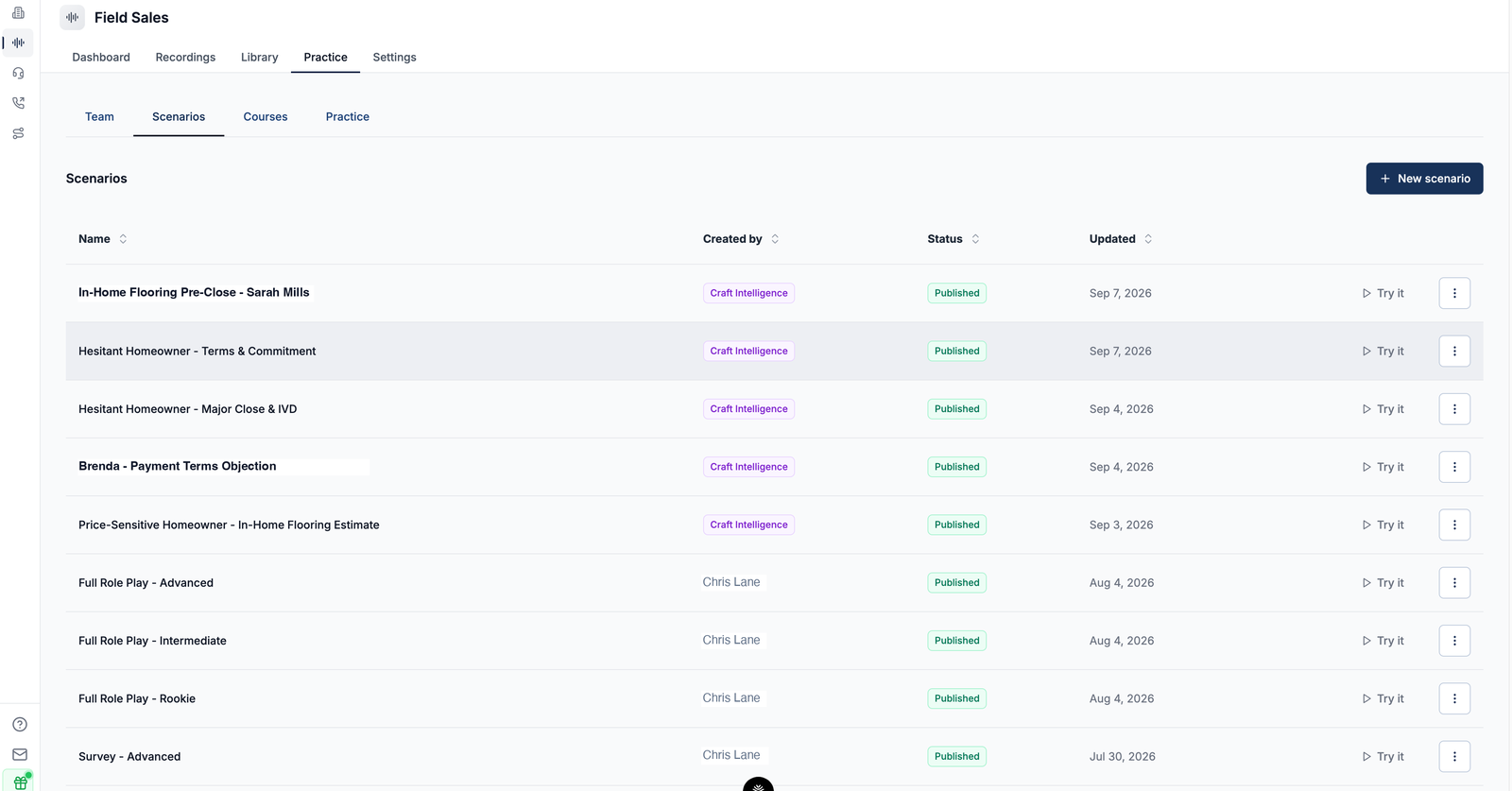
The anatomy of a scenario that gets used
| Element | Weak | Strong |
|---|---|---|
| Customer | “A homeowner interested in windows” | “Retired couple, fixed income, quoted $14k elsewhere, husband skeptical of financing” |
| Objection | “They have concerns” | “‘We never finance anything’ — raised right after the price” |
| Win condition | “Close the sale” | “Get agreement to walk through the financing math before they decide” |
| Length | Full appointment | The 5 critical minutes around the objection |
Short, specific, and winnable in five minutes — that’s what a rep will actually run on the drive between appointments. Set a difficulty when it helps: basic (clean run), realistic (normal friction), pressure test (stacked objections).
Four rules that make the practice stick: let the rep try before you explain, keep the first round short, replay the same scenario after feedback (the second attempt is where the learning shows), and score the attempt against the same scorecard criteria the real appointment uses.
The starter set
If you’re building your first scenarios today, build these six — they cover what costs most teams the most money:
- Price: “that’s more than we expected”
- Spouse: “I need to talk to my wife/husband”
- Competition: “we’re getting other quotes”
- Delay: “we need to think about it”
- Financing: presenting it before the customer asks about price
- The turnaround: customer said no, find the reopening
Make practice the default
Scenarios without a cadence die quietly. Wire them into rhythms you already run:
-
Assign one scenario per week, matched to the team’s heatmap gap. Weak financing scores across the team? Everyone runs the financing scenario this week.
-
Prescribe practice in 1:1s. The behavior a rep commits to in their 1:1 gets a matching scenario: “run the spouse scenario three times before Thursday.”
-
Warm up before real appointments. Top performers run the likely objection on the drive over. Say that out loud to the team — it reframes roleplay from remedial to professional.
-
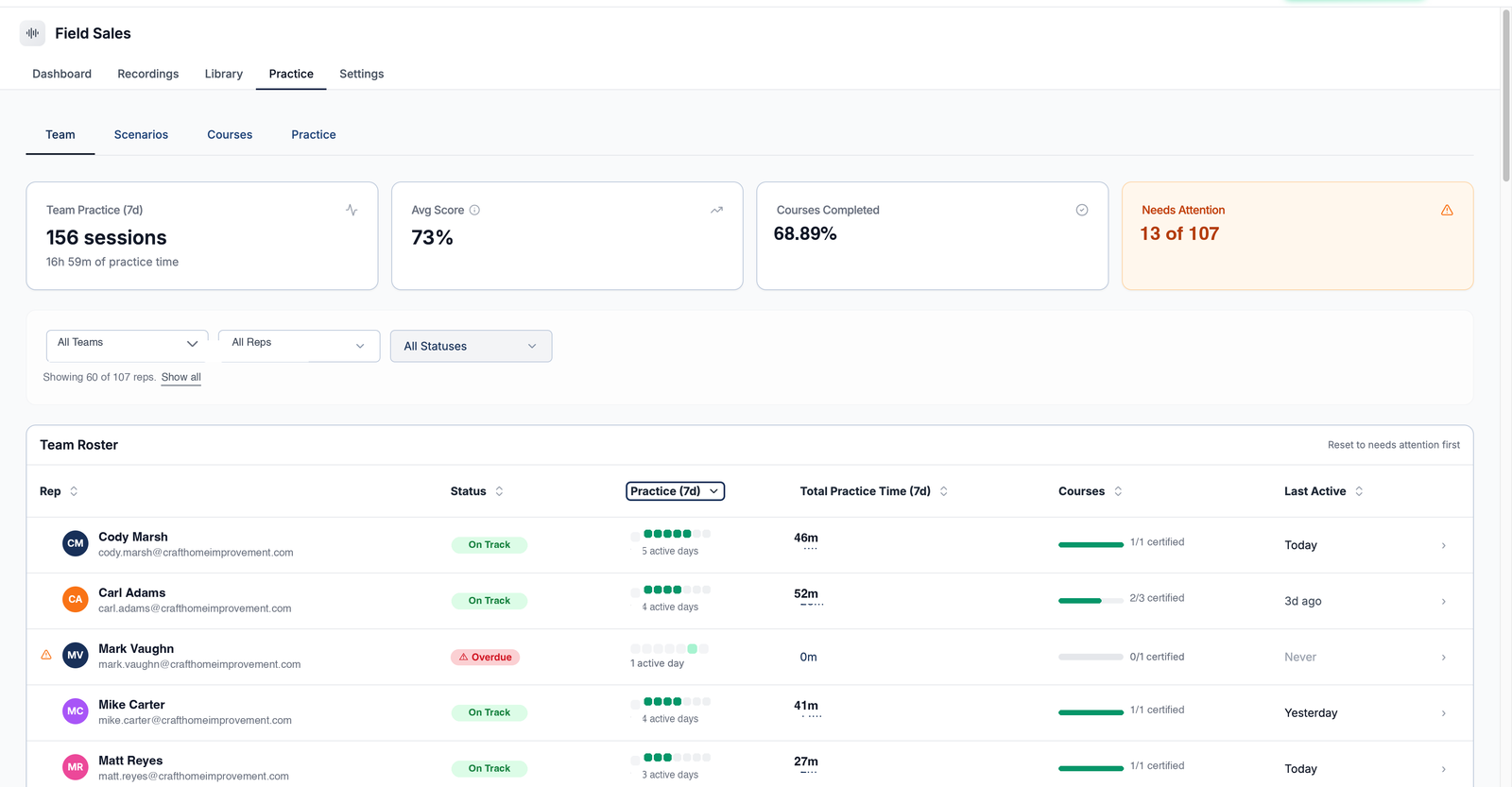
Celebrate streaks publicly. The leaderboard tracks practice streaks; the Friday shout-out makes them cool. Practice is the one stat any rep can lead regardless of talent.
Do this week
Ask Craft Intelligence for your top three lost-appointment objections, build one five-minute scenario for the worst of them, and assign it team-wide with a streak challenge. Next week, check the heatmap for movement on that step.